Prove your training worked
Most programmes report attendance, completion and a happy-sheet score. None of that tells you whether a manager now handles the conversation differently. A behavioural assessment before and after does.
 Watch: training assessments · 1:30
Same scenario. Before and after. Observed, not self-reported.
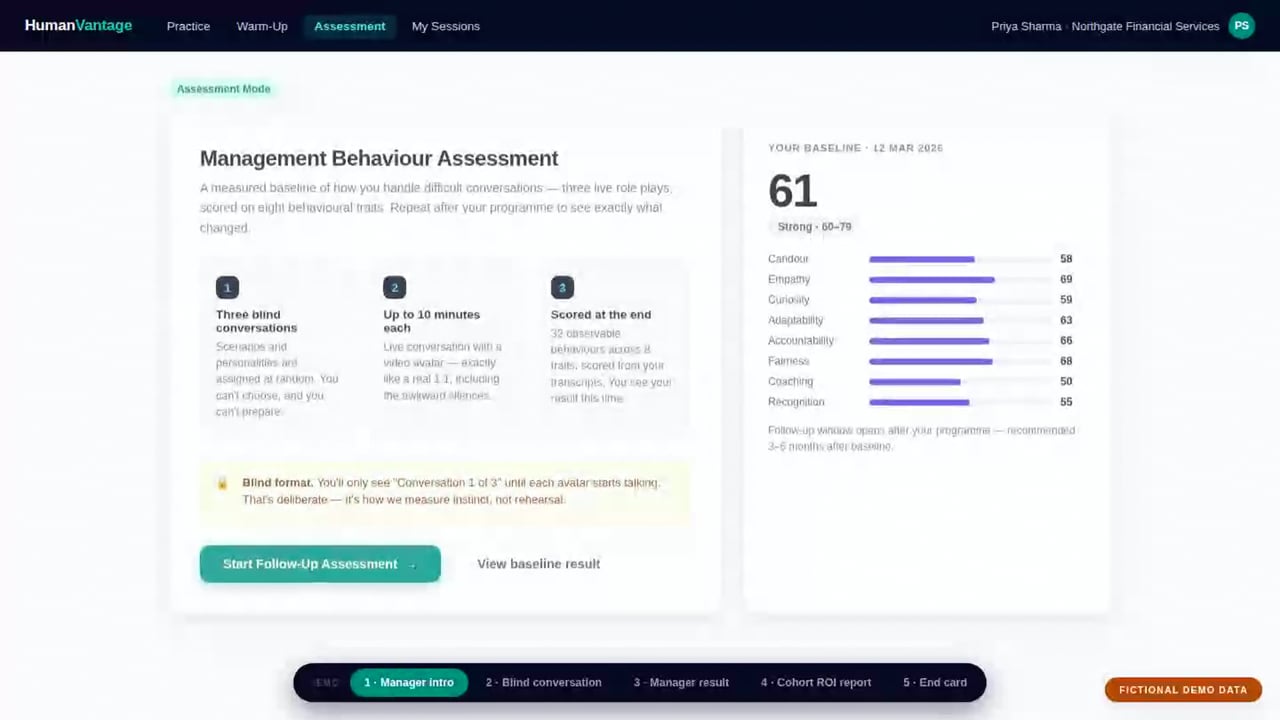
Baseline
Before the programme, each manager completes three blind role-plays. Scenarios and personalities are assigned at random, no choosing, no preparing. Behaviour is scored against research-backed markers: do they name the issue, acknowledge emotion, stay clear under pressure, or default to avoidance?

Your training
Run the programme you already have: your internal course, your external provider, your coaching. HumanVantage doesn’t replace it. It measures it.
Re-assess
Every trait, before and after, including the honest dips. Each manager sees their own movement in private. The shift across the whole management population is your evidence: for the board, for the budget, and for the managers themselves.

The whole cohort, before and after your programme.
Cohort score, completion, the biggest trait gain, how many managers improved, and the non-movers too. Real measurement includes them; that’s what makes the number credible.
For training providers: add measured impact to every programme you sell.
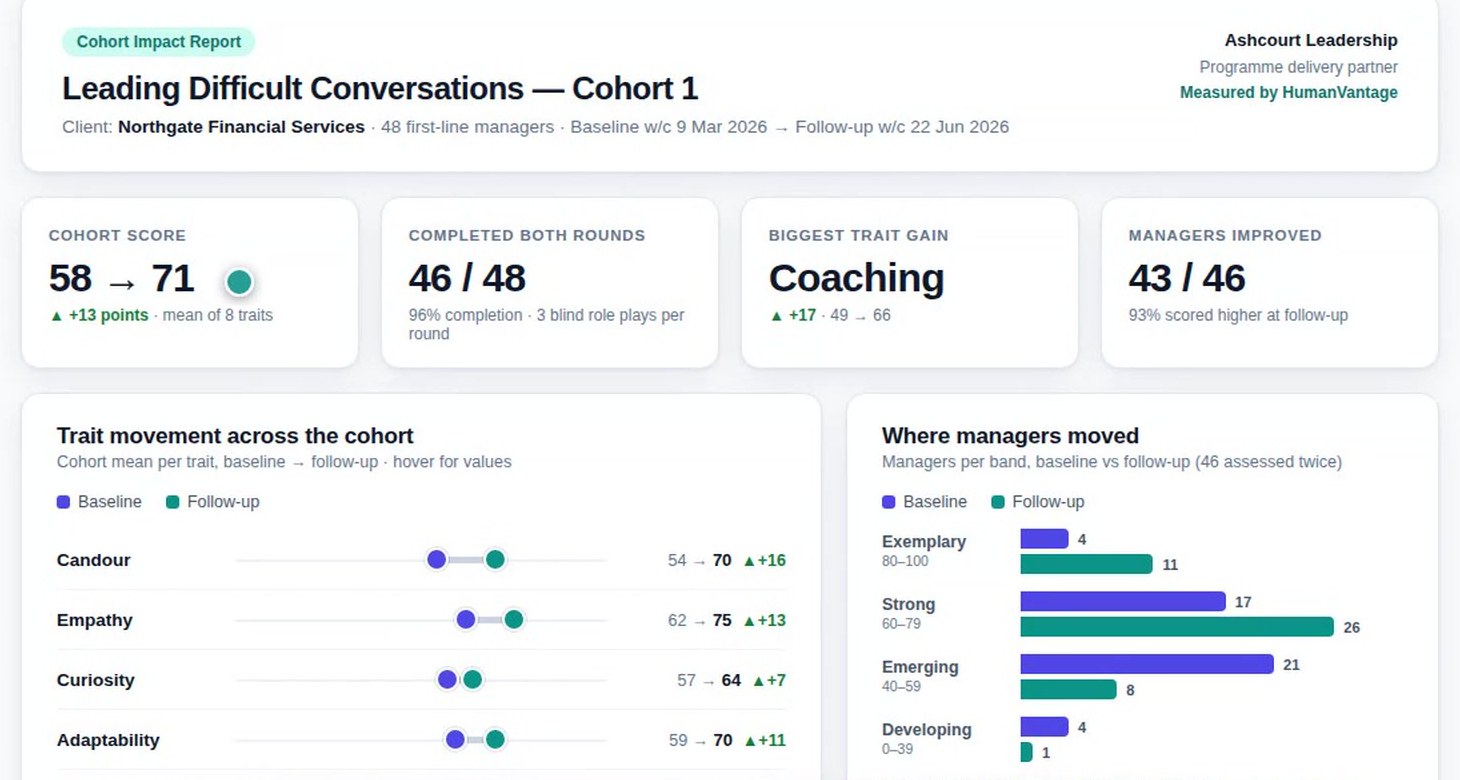
Assessment screens shown with illustrative demo data.
“Confidence went up” is not evidence. A manager who now names the problem in the first two minutes is.
Self-reported confidence is the most common measure of management training and one of the least reliable. People feel better after a good course. Whether they behave differently when someone is upset in front of them is a separate question - and it’s the only one that affects retention, grievances and performance.
What you get
- A behavioural baseline for every manager, in under 30 minutes each
- Team-level before/after comparison - individual scores stay private to the manager
- Which conversation types improved, which didn’t, and where the gaps still are
- A number you can put next to the training spend
Who it’s for
Heads of L&D and People leaders who are asked to justify development spend and are tired of answering with completion rates. Training providers who want to show clients the outcome, not just the delivery.
If you run one management programme a year and can’t currently say whether it changed anything, this is the missing piece.