Prove your programme changed how managers behave. Then help it stick.
A ten-minute scored role-play, run before and after your programme. Same conversation, same avatar, same scoring — the only thing that changes is the manager. And between your sessions, a private place for them to practise what you taught.
No meeting needed to understand it. Watch it, price it into a programme, then decide.
 Watch: the assessment · 1:30
You know the programme worked. Your client wants a number.
The cohort was engaged. The feedback forms came back at four-point-something. The sponsor said lovely things in the wrap-up. And three months later, in the renewal conversation, someone from finance asks what actually changed — and the honest answer starts with “it’s hard to measure, but…”
It isn’t that you don’t know. You watched the managers get better in the room. It’s that the instruments you’ve been given can’t show it. Satisfaction scores measure whether people enjoyed the day. Confidence surveys measure how people feel. Neither tells anyone whether a manager now names the problem in the first two minutes instead of letting it drift for four months.
Then there’s the part nobody puts on the proposal. Whatever people learn in the room, most of it fades in the weeks after — the one study that followed it found 62% of trainees applying what they’d learned straight away, 44% at six months and 34% a year on. The three weeks after your workshop is where the client’s budget quietly dies, and where your reputation for the next renewal is decided.
Two gaps, one cause. You can’t see the behaviour, and you can’t be there when the manager needs to practise it. HumanVantage fixes both.
One platform. Two jobs inside your programme.
A manager has a difficult workplace conversation — out loud, on a video call — with an AI avatar that responds to what they actually say. It gets defensive. It goes quiet. It pushes back. Ten minutes, then it stops. What happens next depends on which job it’s doing for you.
The assessment: before and after
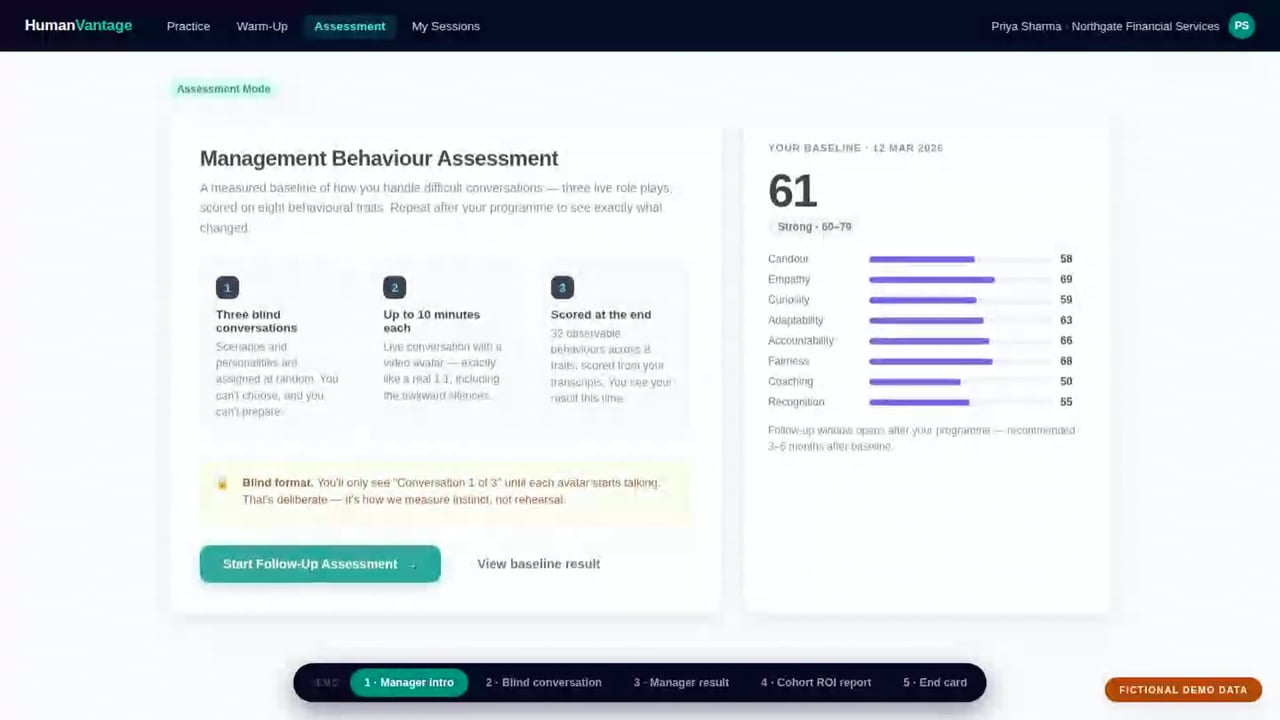
Three to five conversations, and the manager doesn’t know which situation or which person is coming. That’s the difference between watching someone rehearse a scene they chose and finding out what they’d actually do.
Every conversation is scored by our conversational judgment model against eight leadership skills and 32 observable behaviours, checked by human assessors, with every score tied to a moment in the transcript. Run it before your programme. Run the same set after. The movement is your evidence.
The practice room: between your sessions
Between modules, and after the programme ends, managers pick the conversation they’re dreading — declining a pay rise, addressing underperformance, a wellbeing check-in — and rehearse it as many times as they need. Private feedback afterwards: what they did well, what they missed, the moment it turned, two things to try differently. Then they go again.
This is the part of your programme that’s currently missing. You can’t be there on Thursday evening when a manager is dreading Friday morning. This can — and it gives you something concrete to debrief in the next session.
John
Direct, angry, feels hard done by. Doesn’t leave the room happy, because people who’ve just been told no don’t. But there are things a manager can do that make it land better, and he responds to them.
Graham
“Yeah, fine, all good.” Overwhelmed and not saying so. The manager has to work to get anything out of him at all.
Sam
Ambitious, prepared, holds you to account. “Where’s my development plan? You said this would be sorted in Q2.”
Ten scenarios today across performance, conflict, wellbeing, pay and difficult decisions, each with all three personalities. Custom scenarios can be built so a cohort rehearses the conversations your programme is actually about.
Your programme, with a before, a between and an after.
Baseline
Every manager runs the blind assessment. About 30 minutes each, remote, nothing to install. You get the cohort’s starting point before you’ve delivered a thing.
Your programme
Workshops, coaching, action learning — whatever you already run. We don’t design it, deliver it or touch it. We measure it.
Practice
Managers rehearse the scenarios from your sessions, privately, until the principles turn into behaviour rather than notes.
Re-assess
The same blind set, one to three months later, once managers have had real conversations to use it in. The difference is the result.
Your debrief
You take the cohort report to the sponsor. Which behaviours moved, which didn’t, what the next cohort needs. That’s the renewal conversation.
| How partners use it | What the manager does | What you do — and can bill |
|---|---|---|
| Diagnose before you design | Runs the baseline before the programme is scoped. | Design the programme against evidence instead of a needs-analysis survey. Quote against what the managers actually can’t do yet. |
| Prove a programme you already run | Baseline, your programme, re-assessment. | An impact review with the sponsor at the end. Your workshop now has evidence it changed something, and you have a case study you can stand behind. |
| Make a programme stick | Practises between modules and for months after the last one. | A short practice debrief at the start of each module, and a 90-day follow-up the client didn’t have a reason to buy before. |
| Coaching engagements | Rehearses the conversation you coached them on, the night before the real one. | The coaching session you were already having, plus a 15-minute review after they’ve practised. The conversation goes better; you look good. |
| Win the next cohort | — | Walk into the renewal with a before-and-after, not a happy sheet. Word of mouth has been the number-one way training providers win work for years running; a scored result travels further than “the delegates loved it”. |
A typical partner cohort is eight to fifteen managers. Alongside the platform, that’s a diagnostic debrief, a practice check-in per module and an impact review — two to three days of your time per programme that the client had no reason to buy before.
Not a score. A movement.
A single number out of a hundred tells a sponsor almost nothing. The change between the first assessment and the second tells them almost everything. The report shows:
- The cohort before and after, across the eight skills
- Which behaviours moved and which didn’t — so you know what the next cohort needs
- Which conversation types improved: performance, conflict, pay, wellbeing
- Each manager’s own results, with the transcript moments behind every score
- Practice activity between sessions — who rehearsed, how often, what they chose to practise (aggregate, never individual)
- All of it under your branding, presented by you
Observed behaviour, not a questionnaire.
Most Level 3 measurement asks the manager, or their team, what they think changed. Self-assessment tracks how confident and motivated people feel far more closely than what they can do; the largest review of it, across 166 studies, concluded it’s best treated as a measure of feeling, not learning. A 360 tells you how a manager is perceived by people with their own reasons, six months late.
This is different in three ways. It’s blind — the manager doesn’t know which scenario or which person is coming, so they can’t prepare a performance. It’s the same test twice — same scenarios, same avatars, same scoring, so the only variable is the manager. It’s evidenced — every score points at a timestamped moment in the transcript, so a sponsor can read exactly what “names the issue” looked like, and so can the manager.
The scoring framework was developed with organisational psychologists and checked against expert human assessors. It scores what actually happened in the conversation — not talk-time ratios or how many questions were asked. If your client has its own leadership framework, we can align the assessment to it.
Per cohort. Never per seat.
Assessment and practice are priced per cohort, for the life of your programme plus the months after it — so it’s a line on your proposal, not a second budget the client has to find. Set against a leadership programme at two thousand pounds a head, it’s a small part of the fee, and it’s the part the sponsor will remember at renewal.
We price it against your specific programme on the 20-minute call, not from a rate card. There’s nothing to install, no IT project, and onboarding a cohort is one 30-minute call.
It goes inside your programme
You buy the cohort at the partner rate and price your programme however you like. The impact report carries your branding, the practice room is part of what you deliver, and the sponsor sees one joined-up programme with you in front of it. Your client, your invoice, your margin.
We handle onboarding, support and the scoring. The work around it — diagnostic debriefs, practice check-ins, the impact review — is yours, priced by you, invoiced by you.
Built with managers, not for them.
Before it went anywhere near a training programme, HumanVantage ran four pilots with mid-size companies — a fintech, a marketing group, a manufacturer, a care group — with around a hundred managers from first-line to director. The pilots asked one question: would managers actually use it, and would it help?
found it more valuable than the videos and guidelines they’d had before
said they’d use it before a real one-to-one
would recommend it to other managers
said it would reduce their anxiety before a difficult conversation
Roughly two thirds of the managers invited took part — for a development tool, that’s high. The last figure is the one that matters for your programme: anxious managers postpone, and postponed conversations are where the learning goes to die. Pilot figures are from mid-size organisations; your cohort will differ.
Your programme stays yours.
HumanVantage doesn’t design leadership programmes, deliver workshops or coach anyone. We don’t run programmes ourselves and we won’t start, so there’s nothing for us to compete with you on. You stay the expert in the room. We’re the instrument and the rehearsal space.
It doesn’t replace your psychometric. Preference and trait tools tell you who someone is; they aren’t built to move, so they can’t show that your programme changed anything. This measures what a manager does under pressure — the thing your programme was built to change.
And it doesn’t claim to measure pounds. Behaviour is the middle of the chain: if conversations demonstrably improved and the client’s retention or grievance numbers then moved, the story holds together. Without the behavioural link, an ROI claim rests on faith. We give you the link. The calculator helps you and the sponsor put a number next to it.
Is this for you?
Probably yes
- Run leadership or management programmes for client organisations, or in-house, with cohorts of five or more managers
- Your programmes have a start, a middle and an end — something a before-and-after can wrap around
- Cover the conversations managers avoid: feedback, performance, conflict, pay, wellbeing
- Win most of your work on reputation and repeat business, and want the renewal to start from evidence
- Are willing to see the result even if it’s flat — and to change the programme when it is
- Have a cohort starting in the next few months where you’d run this
Probably not
- You deliver keynotes, one-off sessions or e-learning libraries with no cohort to follow
- Your programmes are for individual contributors, sales or customer service — this scores manager skills, not job-specific ones
- Your clients only ever have two or three managers — the cohort view won’t switch on below five, and we’d rather tell you now
- You’re collecting software partnerships rather than looking for something to run in a specific programme
- You want a guaranteed uplift on the page. We don’t sell those, because that isn’t measurement
Three steps. No introductory meeting.
- Watch the walkthrough. Ninety seconds. If it doesn’t make sense for the programmes you run, stop here. It’s at the top of the page.
- Apply. Six questions, about three minutes. What you run, who for, and the programme you’d use this in first.
- A 20-minute call about that programme. If it’s a fit we’ll talk about the specific cohort and the specific managers — not the product — agree how you want to buy it, and get the baseline running before your first module. If it isn’t a fit, we’ll say so by email and won’t take half an hour of your diary finding out.
You’ll hear from Davina within two working days either way. Prefer to talk first? Book a 20-minute call.
Straight answers.
I already do role-play in my workshops. Does this replace it?
No. It’s the practice between your sessions, not instead of them. Role-play in a room full of peers is where people perform for each other; a private rehearsal at nine o’clock the night before is where they experiment. You can’t be there for that. This can, and it gives you something concrete to debrief in the next module.
What if the scores don’t go up?
Then you’ll know, and so will we. Sometimes a behaviour doesn’t move because the programme didn’t touch it; sometimes because the re-assessment came too early. Either way the report shows which behaviours shifted and which didn’t, so the conversation with the sponsor is about what to do next, not about whether the whole thing worked. We won’t put a guaranteed uplift on this page, because a measurement you can only pass isn’t a measurement.
Will managers see it as a test?
The assessment is a named assessment, and managers are told so — the same way they’d be told about a 360. The practice room is different: it’s private to the manager, always, and the organisation only ever sees aggregate patterns. Keeping the two apart is deliberate. The moment practice is scored and visible, managers start performing for the record, and the data stops being worth having.
How much of a manager’s time does it take?
About 30 minutes for the baseline assessment and the same for the re-assessment, remote, at a time that suits them. Practice sessions are capped at ten minutes each, because by minute two you can already tell whether a conversation is going well, and we’d rather managers practise and then go and have the real one.
Can it align to my client’s competency framework?
Yes. The eight skills map onto most leadership frameworks, so we do a read-across rather than a rebuild. Custom scenarios can also be built so the cohort rehearses the conversations your programme is actually about. Tell us about the client and we’ll say straight whether it’s ready for them.
Does it replace our psychometric or 360?
No, and it isn’t trying to. A psychometric tells you who someone is; a 360 tells you how they’re perceived. This tells you what they do when someone is upset in front of them — and whether that changed after your programme. Most partners run it alongside whatever they already use.
Is it AI? Where does the conversation go?
Yes. The avatar is AI-driven, and the feedback comes from our conversational judgment model, checked by human assessors. Practice sessions are private to the manager. Assessment results go to whoever commissioned the assessment. Nothing a manager says is used to train anyone else’s model. UK company, UK data. If your client’s IT or data team has questions, we’ll answer them directly.
Who else is using it?
Four pilots with mid-size firms — a fintech, a marketing group, a manufacturer, a care group — around a hundred managers. With training providers we’re deliberately starting with a small number of partners, which is why the first cohorts get custom scenarios built for them.
Do you sell to my clients directly afterwards?
The platform, yes — that’s the contract. Programmes, workshops, coaching: no. We don’t run them and we won’t start. You’re the programme; we’re the instrument.
Is there exclusivity by region or sector?
No. We’re small and we’d rather not pretend otherwise.
Can the report carry my branding?
Yes. The impact report goes to the sponsor under your name and branding, as part of your programme. What you wrap around it — your debrief, your recommendations, your next-cohort proposal — is yours too.
I became a manager at 21 and made every mistake there is. I told a team a restructure was a great opportunity and was told, flatly, that not everyone wanted to progress — some of them just liked their jobs. Two decades in leadership later, running a global division and then advising companies on strategy, I kept seeing the same thing: the strategy was fine, the training was fine, and the managers still couldn’t have the conversation.
The people running those programmes knew it too. They could see the managers change in the room and had nothing to show for it three months later except a feedback form. Role-play in front of peers doesn’t fix that. It’s awkward, it’s not realistic, and nobody experiments in front of colleagues.
So I built the thing I’d have wanted: somewhere private to practise, with someone who pushes back, and a way to see — honestly — whether the development landed. If you run programmes and you’re tired of defending real work with unreal evidence, that’s who this is for.